Proposal v8 · 2026-08-23 · status: for Byron's yes/no
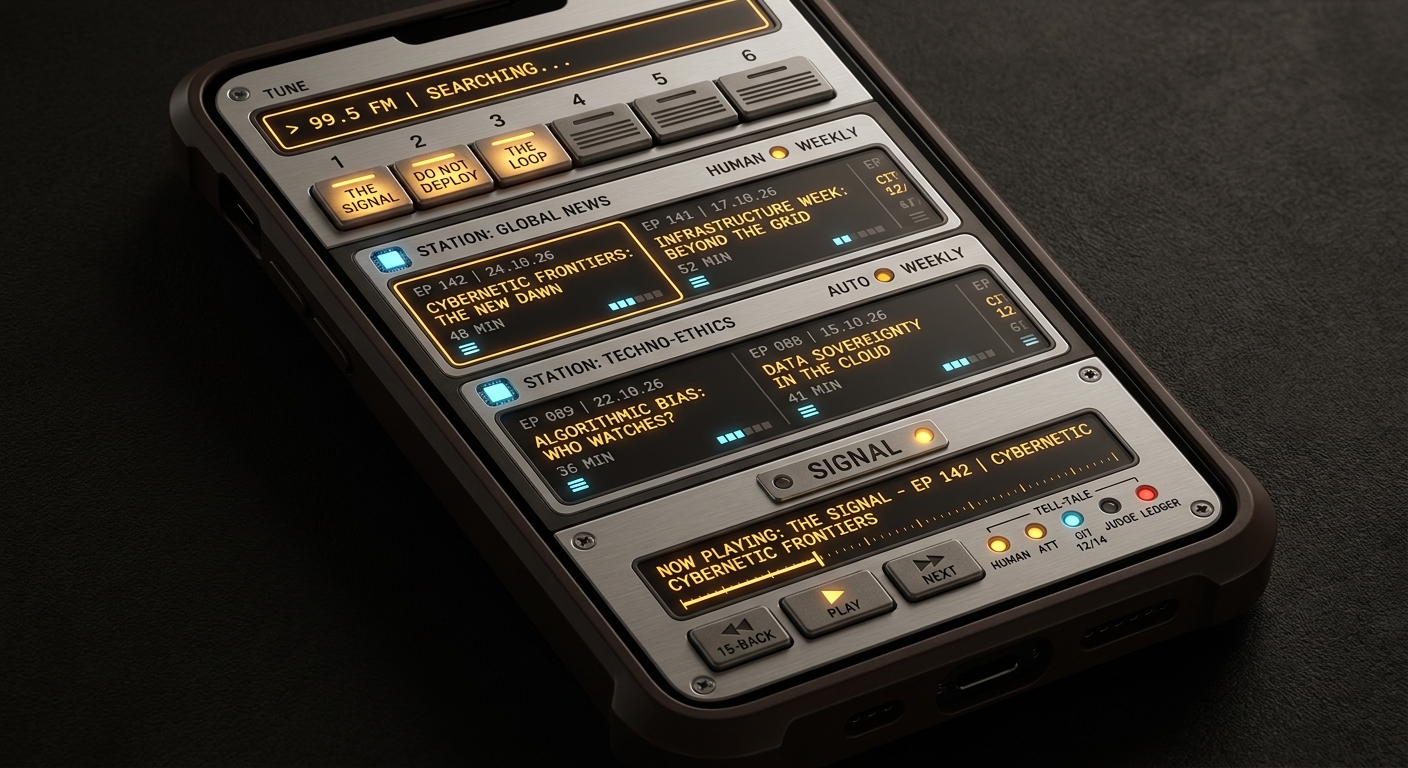
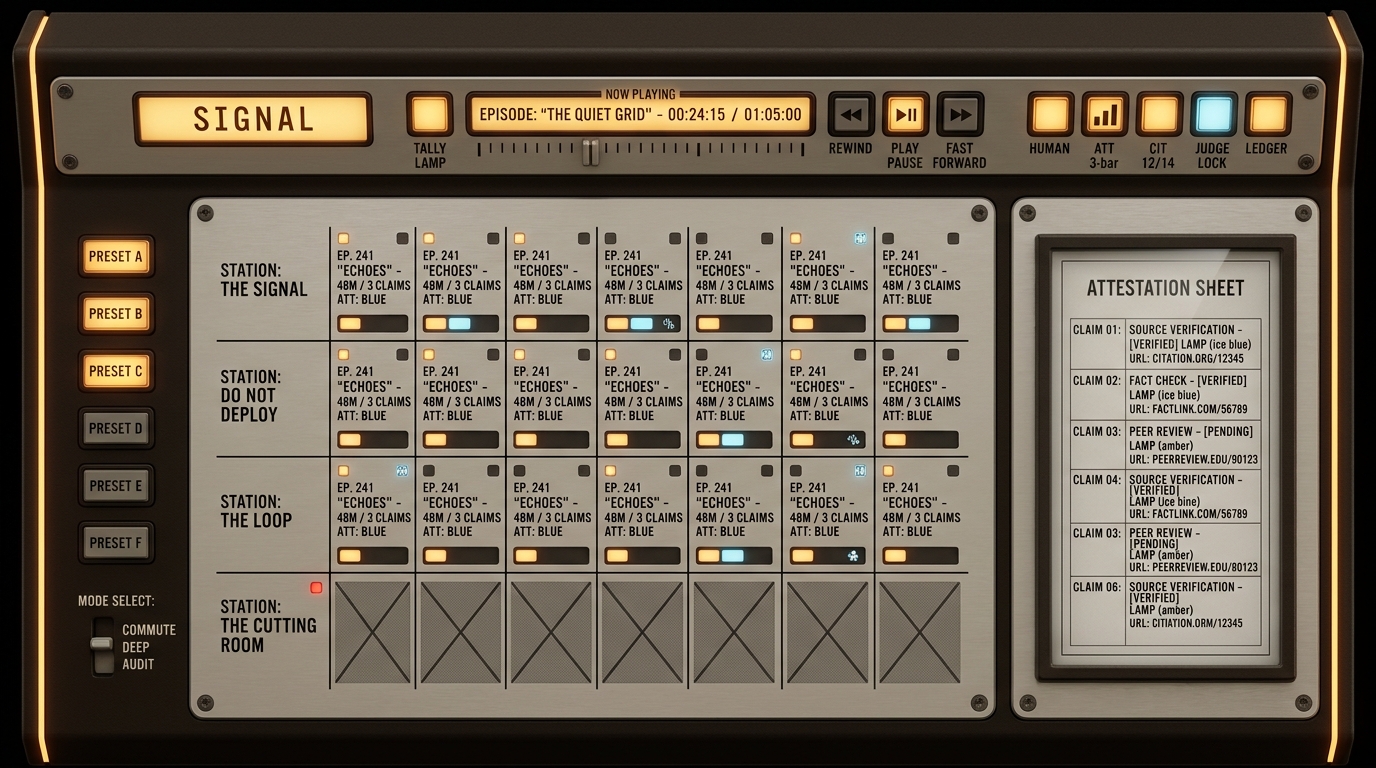
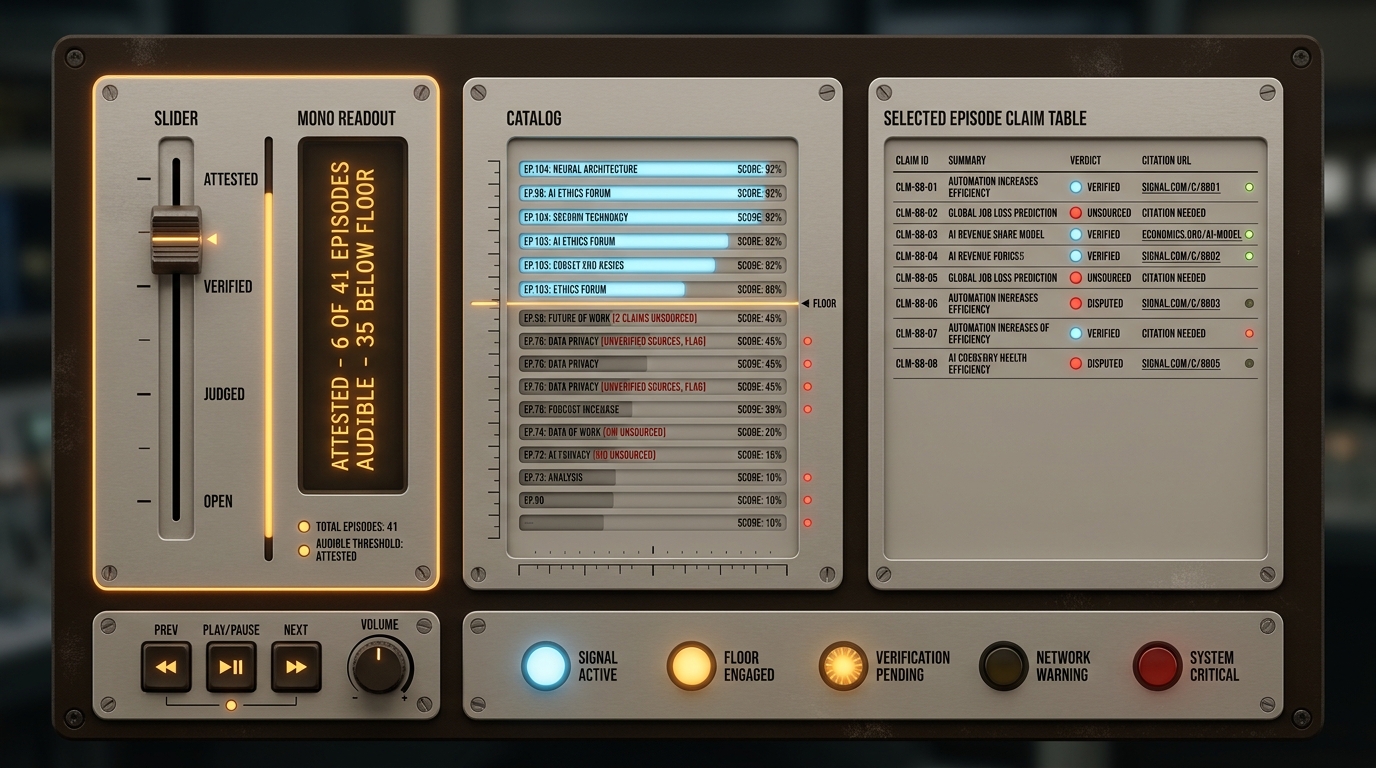
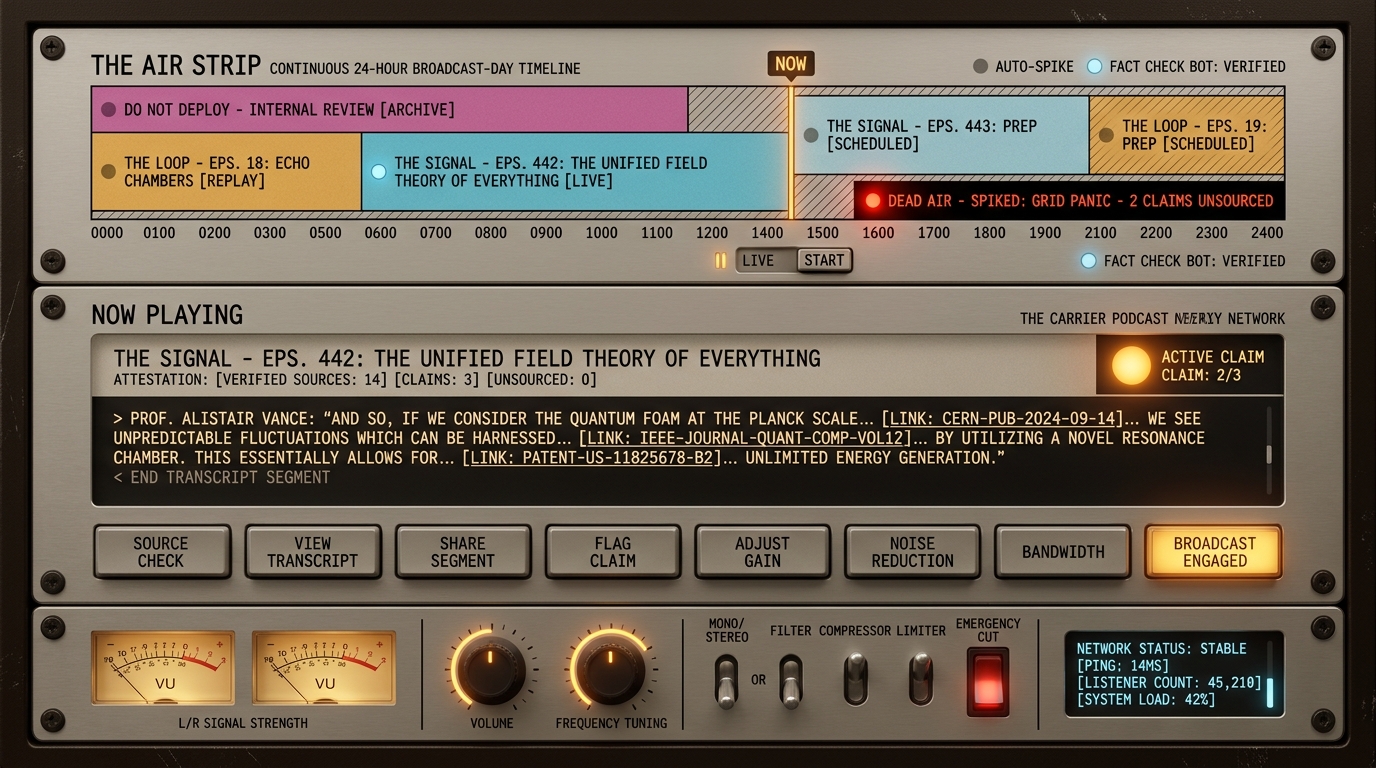
v8 — Byron rejected the dark/retro appliance aesthetic ("lighter, brighter"). Round 8 delivers five light clickable concepts + a light admin → hub at /light.html (Daylight · Frequency · Bloom · Paper · Sky), each with a Nano Banana render. The Round-7 governance furniture (tell-tales, attestations, Cutting Room, kill rate, Noise Floor logic) survives inside every light concept; only the dark chassis died.
v7 adds Round 7 — the industrial/appliance exploration Byron requested: a 3-user ideation round + 4-expert industry panel converged on THE FACEPLATE + NOISE FLOOR (+ THE CARRIER wildcard), Fable-critiqued, with Nano Banana Pro high-fidelity renders. See §14 and the concept ledger.
v6 adds Byron's bold direction: the agentic command tuner ("don't browse — tune"), the bold Lineup mockup, HUMAN-CURATED vs AUTO station badges, the narrowcast primitive (podcast-send: link+QR+email/text), OB1 + daily-scrape context ingestion, per-station channel declarations (cadence/tier/cost/curation), Spotify syndication via per-station RSS, and a live agent-run citation-validation test on Signal Ep 1 (results being appended).
Brand: SIGNAL (Byron's call, replacing the ARNAO.FM working title) — platform home: https://signal.arnao.ai. His existing weekly show The Signal** already lives there with real brand equity (live RSS, approval-gated pipeline, cloned-voice episodes); the platform extends the show's name into a network — like a show growing into a label — rather than inventing a new brand next to it.
Why this does NOT break the existing site (path-preserving takeover):
v5 = v4 + Byron's naming call. v1→v2 UX+panel in §11; v2→v3 Fable in §12; v3→v4 streaming Lineup in §13.
Promote the Do Not Deploy pipeline from a one-off show into the podcast primitive for Byron's brand: one public platform holding every show, every voice, every format. Do Not Deploy (https://donotdeploy.arnao.ai) and The Loop (https://comedy.arnao.ai) become the first stations. Everything proven — cloned-voice rendering, per-turn audio caching, kill switch, privacy rules, voting, Plausible analytics — is inherited platform-wide, not rebuilt.
The governing thesis (sharpened by the Fable pass): at the level Byron is playing for, scarcity signals authority and throughput signals hobbyist. So the visible product is not the content engine — it is the governance apparatus around the content: provenance edges, dated truthful attestations, a public Disagreement Ledger, and a public log of episodes Byron refused to ship. The platform generates easily precisely so the refusals are cheap enough to be real.
Streaming-service DNA, tuned by asking. Landing = a home screen structured like the platforms people already know (Netflix/Prime/Spotify) — but the headline interaction is the agentic tuner: one big command bar. "5 minutes on data centers, both sides, two voices" is the modern equivalent of turning a dial — tuning by intent instead of frequency. For visitors it's search-plus-filters over the catalog; for Byron (and, gated, for invited creators) the same bar composes new episodes on the fly — the input shows cost tier, render ETA, and "→ review queue, not air" before anything runs. Bold visual language: deep-space ground, an animated electric spectrum bar as the brand device, one neon band color per station, glassy animated jacket cards.
prefers-reduced-motion, per-episode lang, transcripts inline, AI-disclosure in audio AND text).Material over hue: milled aluminium + warm glass, never black-plus-neon. Palette: umber chassis #17130E · shadow-cut #2A241D · brushed face #B6B0A4 · dial lamp #F2B45C (light source only — bloom, edge; never a fill) · meter blue #9CD6E6 (verified states) · dial-face glass #E4E6DE (light mode = the unlit printed dial, not an inversion). Type: Chivo Condensed caps for nameplates; IBM Plex Sans with JP/KR/SC/TC siblings (chosen for script coverage — multilingual is first-class); IBM Plex Mono tabular figures for every number. Motion: transform+opacity only, 180ms snaps, no ambient idle loop (the strongest AI-tell there is).
Listened in full / Claims verified against sources / Summary reviewed. Never a bare "reviewed by" over a skim — Fable's sharpest finding: a vague attestation converts a pipeline error into a personal credibility event.Owner-gated (Career-Triage auth pattern), four zones:
A. Generate — one command bar: "5-minute smoke test on data centers, pro AND con, with citations, my voice + Vera, funny-leaning" → parsed into show/format/length/voices/mood/citations/judge/language. Presets + steering box, never a wizard. Model tier is a per-show policy set once (override available), not five switches per episode.
B. Review queue — cheat sheets, not audio files: exec summary · claim/citation status · privacy-scan hits · cost · length; adversarial spot-check ▶ (30s assembled from privacy hits + judge failures + the two highest-uncertainty claims — risky lines, not highlights); diff-from-last for recurring shows; Edit-line re-renders one turn (per-turn cache) with A/B listen-back; Approve ≠ Publish (approve = cleared-for-air; publishing is a scheduled slot per the standing cadence rule — batch approval can never batch-release). Per-show policy dial Manual → Cheat-sheet → Auto (comedy only). Approval needs land in the surfaces Byron already checks: needs-byron slog + Signal digest + Desk. No new inbox.
C. The governor — caps review debt, not just dollars. Fable's correction, adopted: dollars were never the scarce resource; Byron's attention is. Generation pauses when pending approvals exceed N (default 3). Secondary: month-to-date spend meter per show with a hard monthly cap, and a live job-state strip (queued → scripting → judging → rendering → jacket, elapsed, stuck-alarm, cancel) so silence is never ambiguous. The dashboard also shows minutes-of-review per published minute — the honesty metric behind the attestations.
D. Fleet hooks — the published primitive. Generate is also the fleet skill podcast-generate, published to every agent (Gia/Mia/Cia/Tia + Claude Code): "Gia, make me a funny 5-minute episode on datacenters in Japanese" from Telegram works with the same toggles and the same governor. Companion skill podcast-send handles narrowcast delivery (link + QR + email/text via the gog-in-gia path). The skill enqueues a typed job (proven voice-platform Blob-queue + Mac watcher); agents never run the pipeline inline — the fix for the million-token translation burn: outline → segments → per-segment render, each a bounded fresh call, per-segment caching, Batch API (50% off) for anything async. Context ingestion: generation jobs pull from what the fleet already knows — OB1 recall, Gia's daily scrape (podcasts, X/AI, Reddit, dissenting voices), the Signal ledger — so "my point of view on data centers" means Byron's actual recorded positions plus this week's actual discourse, not a cold-start essay. Channels (auto-creating stations) are declared per show: cadence + model tier + cost ceiling + curation mode (human-gated vs judge-gated auto), all enforced by the governor.
| Tier | Model | $/M in/out | Use | Script | +Judge | +Council | +i18n/lang |
|---|---|---|---|---|---|---|---|
| Overnight/free | Local qwen2.5-coder:32b | $0 | "Don't care how long": drafts, translations, cleanup | $0 | $0 | $0 | $0 |
| Cheap | GLM-4.6 (OpenRouter) | $0.43 / $1.75 | Bulk work, judge, panelists | ~$0.10 | +$0.05 | +$0.15 | +$0.10 |
| Standard | Claude Sonnet 5 | $3 / $15 (intro $2/$10 expires 8/31) | Everyday scripts | ~$0.45 | +$0.10 | +$0.30 | +$0.45 |
| High | Claude Opus 5 | $5 / $25 | Flagship scripts, nuanced satire | ~$1.10 | +$0.10 | +$0.40 | +$1.10 |
| Signature | Claude Fable 5 | $10 / $50 | Brand-critical theses | ~$3 | +$0.10 | +$0.50 | n/a (translate on Cheap) |
Voice render local Chatterbox $0 + Gemini TTS characters (cents); jacket ≈ $0.13. GPT-5.6 Sol ($2.50/$15 — OpenRouter's 50% promo through Sep 18) = optional High alternate; a promo, not a floor. GLM-4.6 also = designated cheap coding model for platform build chores. And per Fable: even at 10× these numbers the dollars are noise — the governed resource is attention, hence zone C.
EXTRA_VOICES (Vera, Lincoln, Jefferson, announcer…). New characters = new recipe rows, not new infra.#EXAGGERATION/#TEMPO): comedy read · "center of authority" · serious/security.Byron asked for a test; it ran on 2026-08-23. An agent with only web access independently re-validated all ~14 load-bearing claims of the live public episode The Signal Ep 1, 34 days after air — full report + verdict table. Findings: 7 claims fully supported, 4 with paraphrase drift ("permit pause" aired as "banned"), 1 factually inverted, and zero citations on any public surface — the episode fails the proposed gate on process before facts. The self-demonstrating part: the one segment where the pre-air Council judge fired (Byron intervened, citations forced in) is the only segment that verifies cleanly at full precision a month later. The gate works where it fires; the platform makes it fire everywhere, and publishes the citations that already exist on disk into the feed. This test doubles as the platform's first public RAI proof point.
| Piece | Source | Status |
|---|---|---|
| Script→voice render, per-turn cache | ~/dnd-show/render_episode.py | proven |
| Character voices | EXTRA_VOICES (Gemini TTS) | proven |
| Byron's voice | ~/voice-clone (Chatterbox) | proven |
| Async job queue + watcher | voice-platform standup engine | proven |
| Kill switch | ~/ops/bin/comedy-killswitch (extends per-station) | proven |
| Privacy scan | comedy privacy-check.py + show-format.md | proven |
| Analytics | self-hosted Plausible + custom events | proven |
| Voting | DND ballot pattern | proven |
| New | Wall UI, trust layer (ledger/spike/attestations), Mission Control, jacket generator, skill, governor | to build |
The honest read: plumbing proven, product new — which is why committed scope is §8's P1 only, and everything else is earned by usage data (Plausible decides, not enthusiasm).
info.arnao.ai card with full enrichment (art + Veo motion + dossier), evolution preserved; SherpaDude front-door listing; per-station RSS + master; open-graph everywhere; sitemap free from the DOM list; command.arnao.ai tile on ship. Platform public; admin/cost owner-only; never-public list respected.
podcast-generate primitive, review-debt governor, judge tier, new shows.Run-rate: auto-weekly show at Standard ≈ $3–6/month all-in; flagship Fable episode ≈ $4–6. Hosting static, ~$0.
| What | Link |
|---|---|
| Mockup — THE LINEUP (bold concept, start here) | https://fm.arnao.ai/lineup.html |
| The Signal (existing show → flagship station) | https://signal.arnao.ai |
| Earlier concepts — wall/instrument A/B | https://fm.arnao.ai/tuner.html |
| Mockup — Mission Control | https://fm.arnao.ai/admin.html |
| Full Fable critique (verbatim) | https://fm.arnao.ai/fable-critique.html |
| Live citation-validation test (Ep 1) | https://fm.arnao.ai/validation-ep1.html |
| Do Not Deploy (live) | https://donotdeploy.arnao.ai |
| The Loop (live) | https://comedy.arnao.ai |
| Voice studio (engine donor) | https://voice.arnao.ai |
| RAI surface (cross-link target) | https://rai.arnao.ai |
| GLM-4.6 pricing | https://openrouter.ai/z-ai/glm-4.6 |
| GPT-5.6 Sol pricing | https://openrouter.ai/openai/gpt-5.6-sol |
| Sol promo context | https://www.explainx.ai/blog/openrouter-gpt-5-6-sol-50-percent-off-promo-not-price-cut-august-2026 |
Full-screen dial demoted (wall became the page) · accessibility promoted to launch gate · RSS promoted to first-class with per-station feeds and provenance-as-text · auto-approve hard-locked off for RAI/AI stations + human attestations · Disagreement Ledger added · cost switchboard → per-show policy + meter · Approve split from Publish per the cadence rule · adversarial spot-check · A/B listen-back · diff-from-last · commute-length tier · language chips replaced flags.
Fable 5 reviewed v2 as a ruthless critic. Its verdicts and what changed:
Byron asked for an industrial/appliance exploration (car dash · refrigerator panel · receiver · SiriusXM), a fresh ideation round, and high-fidelity renders. Process: 3-user ideation workshop + 4-expert industry panel (automotive HMI, Rams/TE industrial design, streaming product, broadcast engineering) → synthesis → Fable adversarial pass → Nano Banana Pro renders. Full record: concept ledger · round-7 synthesis · Fable round-7 critique.
The palette correction (expert panel, 4-0, adopted): v6's neon gradient + perpetually-animating spectrum contradicted our own settled rules. The appliance direction wins: umber chassis, brushed aluminium, amber as lamp-light only, meter blue for verified. Motion is evidence, not decoration — nothing on screen moves unless real state changed.
What ships (Fable's resolution, adopted):
Byron picked the wall over the instrument and asked for more: streaming-service DNA. What changed: